
What Is NCCO Technology?
A Plain-Language Guide to How It Cleans Indoor Air
If you’ve been shopping for an air purifier in Canada, you’ve probably run into a wall of acronyms: HEPA, PECO, ionizers, activated carbon, and — if you’ve come across b-MOLA — NCCO. Most of these technologies work in fairly similar ways: they catch pollutants and hold onto them. NCCO does something different, and that difference is worth understanding before you decide what’s actually right for your home.
This is a plain-language explainer — no sales pitch, just how it actually works.
What Does NCCO Stand For?
NCCO stands for Nano-Confined Catalytic Oxidation. It’s a patented air purification technology, originally developed in partnership with a member of the Hong Kong University of Science and Technology (HKUST) Entrepreneurship Program.
The name sounds technical, but the idea behind it is fairly simple once you break it down.
How It Actually Works
Most air purifiers on the market today rely on trapping pollutants — a filter catches particles, odours, or chemicals, and holds onto them until the filter is full and needs replacing. That’s true of activated carbon, and it’s a big part of why those filters need to be swapped out so often.
NCCO takes a different approach: instead of just trapping pollutants, it breaks them down.
Here’s the process, step by step:
1. An active oxygen generator produces a low concentration of active oxygen — a highly reactive form of oxygen that’s effective at breaking down pollutants.
2. A zeolite-based reactor — zeolites are minerals with nano-sized pores — adsorbs pollutants and holds them in place, confined within those nano-scale tunnels.
3. Inside those pores, the trapped pollutants and active oxygen react together, and the pollutants are oxidized — chemically decomposed — into water vapour and carbon dioxide, released as harmless byproducts, regenerating that same site to adsorb the next pollutant.
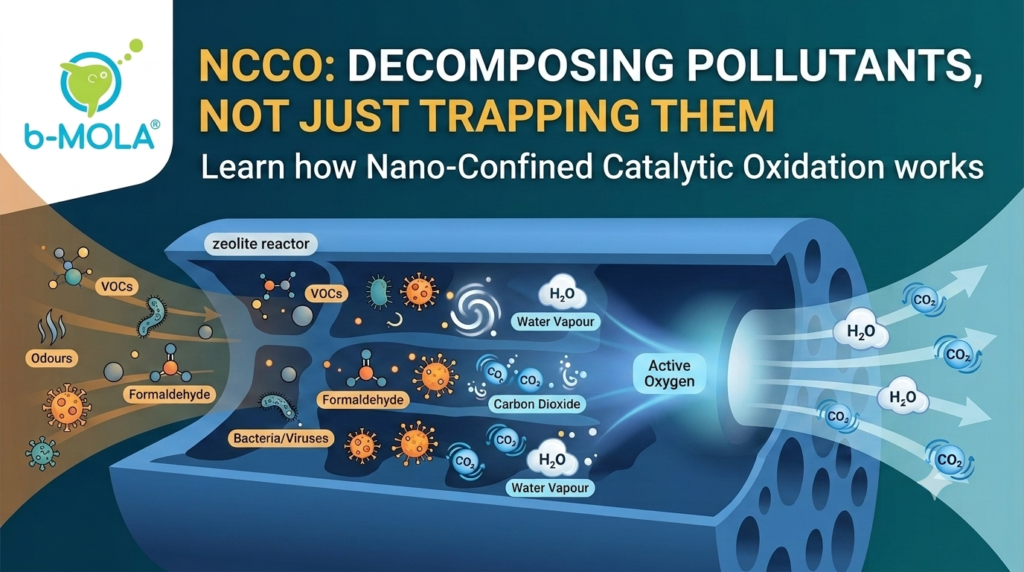
Because the pollutants are actually broken down rather than just captured, the reactor doesn’t accumulate waste the way a filter does. There’s nothing building up that eventually needs to be thrown away — which is also why it’s designed to keep working for years instead of months.
A simple way to think about it: a carbon filter is like a sponge — useful until it’s full. The NCCO reactor is more like a drain — it doesn’t fill up, it processes what comes through.
Why This Means Lower Maintenance Cost
This is where NCCO’s design actually shows up in your day-to-day life — and your wallet.
With a typical activated carbon filter, the material physically holds onto odours and chemicals until it’s saturated, at which point it needs to be replaced — often every few months. Not only is that an ongoing cost, but a saturated filter can even start releasing what it’s absorbed back into the air, an effect sometimes called secondary pollution.
The NCCO reactor works differently. Because it decomposes pollutants instead of just storing them, it doesn’t saturate the same way. Documentation on file shows it’s been tested to run continuously for years in laboratory conditions.
That doesn’t mean nothing in an NCCO-based unit ever needs attention — a HEPA filter stage still works alongside the reactor to capture fine particles, and that HEPA stage does need periodic replacement, just far less often than a typical activated carbon filter. In practical terms: you’re maintaining one component on a much longer cycle, not swapping out a saturating filter every few months. For anyone who’s ever budgeted for ongoing filter replacement costs, that’s a meaningful difference over the life of the unit.
What NCCO Is Actually Tested Against
Per the product documentation on file, NCCO-based units have been tested against:
– Bacteria and viruses, including common organisms used in standard air purifier testing
– Volatile organic compounds (VOCs), including formaldehyde — a common concern after a renovation or new furniture purchase
– Fine particulates, via the HEPA filtration stage that works alongside the NCCO reactor
No air purifier — NCCO-based or otherwise — can honestly claim to test against every bacteria and virus that exists; new and untested organisms are always out there. The b-MOLA NCCO series is UL and CSA certified, the certifications that matter most for the Canadian market. Beyond that, the underlying NCCO technology has also undergone independent accredited laboratory testing against specific, named organisms — including human coronavirus (HCoV-229E), Influenza H3N2, Staphylococcus aureus, and E. coli — with results consistently in the 99.9% to 99.99%+ removal rate range. In short: where it’s been tested, it performs consistently in the high-99% range — that’s a documented lab result, not a marketing estimate. It also avoids the secondary pollution issue that can affect a saturated carbon filter.
Is It Safe?
A fair question, since “active oxygen” can sound a little alarming if you haven’t come across the term before.
Active oxygen is a general term for reactive oxygen species — the kind of thing that also occurs naturally (lightning and thunderstorms produce it too). The way it’s used here matters: the fan in an NCCO-based unit is positioned so that the active oxygen is drawn into the reactor itself, rather than released into the room. The reaction happens inside the unit, not in the air you’re breathing.
A Quick Note on Certification
The b-MOLA NCCO series air purifiers are UL and CSA certified — recognized marks for the Canadian market.
The Bottom Line
NCCO isn’t a magic fix, and no honest air purifier company should claim it is. But if you’re comparing technologies and trying to understand *why* one option costs more upfront but less over time, or why one purifier needs a new filter every few months while another doesn’t — this is the mechanism behind that difference. It’s not about trapping pollutants better. It’s about not needing to trap them at all.
Soft, educational close — no hard sell. Suggested: “Curious which b-MOLA model fits your space?